


Scope 3 emissions are greenhouse gas emissions that occur outside a company’s reporting boundary, which means that they are emissions from activities and sources that a company does not directly own or control. They are linked to the company’s value chain and arise from third-party activities the company depends on to deliver its products or services. This includes upstream emissions from suppliers—such as the production of raw materials, manufacturing, and transportation—and downstream emissions from how products are used by customers and eventually disposed of.
Why scope 3 matters for your business
Scope 3 emissions often account for 70–90% of a company’s total carbon footprint, making them the largest and most challenging source of greenhouse gas emissions. Ignoring Scope 3 emissions means overlooking the majority of your climate impact. Addressing these emissions is critical for several reasons:
- Regulatory compliance: Emerging disclosure requirements (e.g., CSRD in the EU, SB 253) increasingly mandate reporting on Scope 3 emissions.
- Investor and customer expectations: Stakeholders are demanding transparency and credible climate strategies. Scope 3 data is essential for ESG ratings and sustainability commitments.
- Risk management: Supply chain disruptions, resource scarcity, and reputational risks are tied to carbon-intensive value chains. Understanding Scope 3 helps mitigate these risks.
- Competitive advantage: Companies that measure and reduce Scope 3 emissions can differentiate themselves, attract sustainability-conscious customers, and unlock cost efficiencies.
Calculating Scope 3 emissions allows businesses to not only comply with regulations but also strengthen resilience and create long-term value. So how can companies begin collecting this data in a meaningful and manageable way?
1. Understand what scope 3 covers
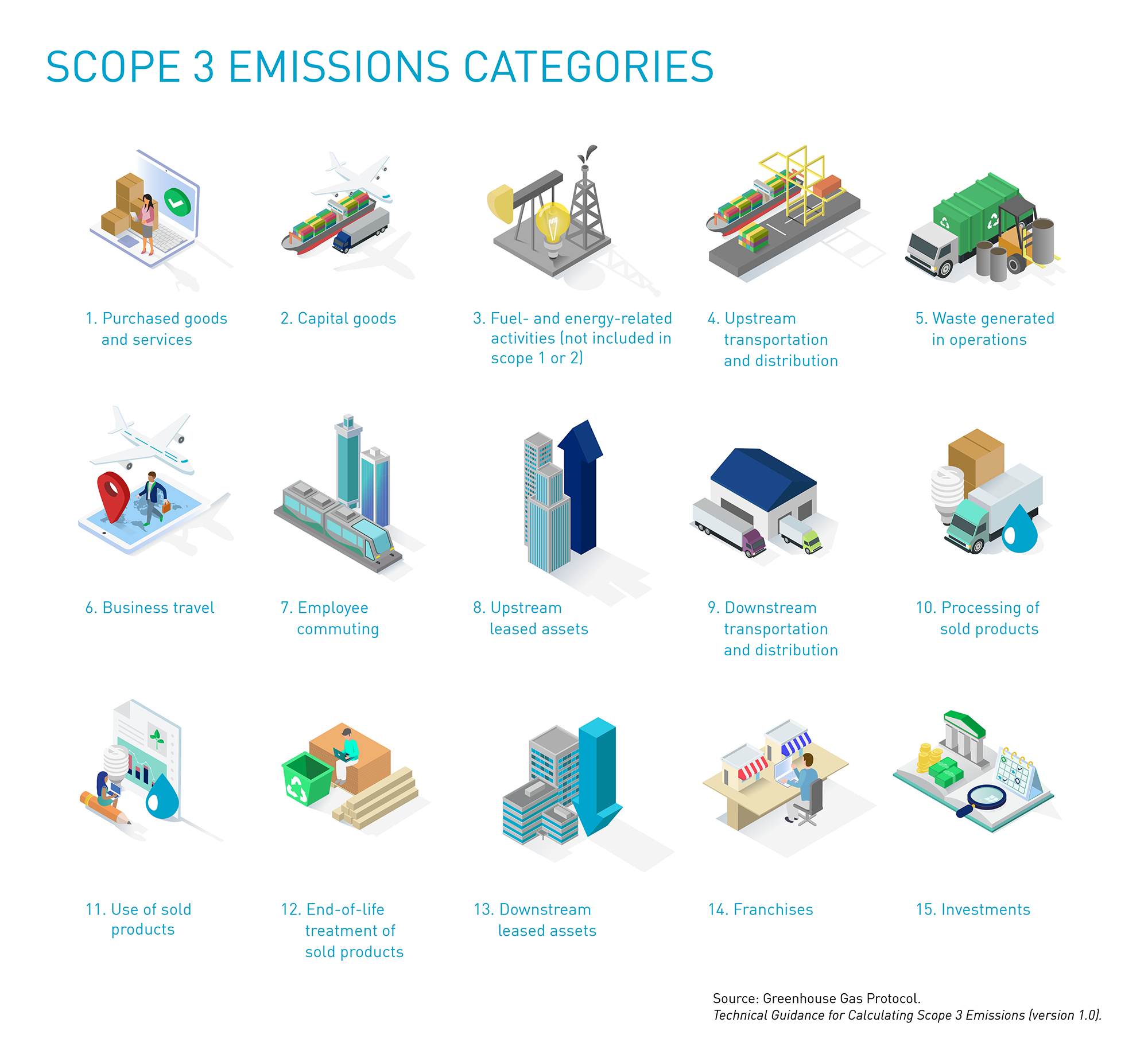
The Greenhouse Gas Protocol breaks Scope 3 into fifteen distinct categories. These range from purchased goods and services to investments:
| Scope 3 Category | Description | Examples |
| Category 1: Purchased Goods & Services |
Emissions from the production of goods and services that the company buys for its operations. | Raw materials from suppliers, packaging materials, IT services, Professional services |
| Category 2: Capital Goods |
Emissions from producing long-term assets purchased by the company, which are used in operations but not sold. | Office buildings, machinery, vehicles |
| Category 3: Fuel- and Energy-Related Activities |
Emissions from extracting, producing, and transporting fuels and energy purchased by the company, not already included in Scope 1 or 2. | Oil extraction for purchased fuel, electricity transmission losses |
| Category 4: Upstream Transportation & Distribution |
Emissions from the transportation and distribution of products purchased by the reporting company. | Shipping raw materials from suppliers, air freight |
| Category 5: Waste Generated in Operations |
Emissions from disposing of waste produced by the company’s own operations. | Landfilling office waste, recycling scrap materials |
| Category 6: Business Travel |
Emissions from employee travel for business purposes. | Flights, rental cars, hotel stays |
| Category 7: Employee Commuting |
Emissions from employees traveling to and from work. | Personal vehicles, public transportation, work-from-home emissions |
| Category 8: Upstream Leased Assets |
Emissions from assets leased by the company (upstream), where the lessor owns and operates the asset. | Rented office space, leased equipment |
| Category 9: Downstream Transportation & Distribution |
Emissions from the transportation and distribution of products sold by the reporting company. | Shipping finished products to retailers, last-mile delivery |
| Category 10: Processing of Sold Products |
Emissions from processing intermediate products sold by the company before they reach the end user. | Food processing, assembly of components |
| Category 11: Use of Sold Products |
Emissions from customers using the company’s products during their lifetime. | Fuel burned in cars, electricity used by appliances |
| Category 12: End-of-Life Treatment of Sold Products |
Emissions from disposing of products after customers finish using them. | Landfilling, recycling, incineration |
| Category 13: Downstream Leased Assets |
Emissions from assets leased to others by the company (downstream), where the lessee operates the asset. | Buildings leased to tenants |
| Category 14: Franchises |
Emissions from franchise operations not owned by the reporting company but operating under its brand. | Energy use in franchise stores |
| Category 15: Investments |
Emissions from companies or projects in which the reporting company has invested. | Portfolio companies’ operations, project financing |
Why do Scope 3 categories matter?
Knowing what each Scope 3 category includes gives your company a practical framework for action. With this knowledge, your business can identify which activities fall under its responsibility, map emissions across the value chain, and prioritize areas for reduction. It enables you to engage suppliers and partners, design targeted strategies for procurement, transportation, and product lifecycle, and improve reporting accuracy. In short, understanding these categories turns a complex challenge into a structured plan for reducing emissions and meeting sustainability goals.
2. Conduct a scope 3 screening assessment
Not all categories apply to every business. Your company will need to identify which of the Scope 3 categories are material to your operations and where to prioritize data collection.
A Scope 3 screening assessment is a high-level estimate of emissions across all fifteen Scope 3 categories. This foundational exercise helps you:
- Determine which categories contribute most significantly to your value chain emissions
- Identify data gaps and areas of uncertainty
- Pinpoint where deeper analysis or supplier engagement is needed
How to conduct a screening assessment:
Step 1: Map your value chain
Before collecting any data, map your operations and supply chain to associated scope 3 categories. For example:
- Do you purchase raw materials or services? → Category 1
- Do you invest in capital projects? → Category 2
- Do you ship products to customers? → Category 9
- Do you have franchises or investments? → Category 14 & 15
Step 2: Use screening tools
Detailed data isn’t required for screening assessments. Use spend-based or industry-average tools to estimate emissions for each category. The tools below apply emission factors to financial spend or activity proxies.
| Tool | Type | Data Needed for Screening |
| GHG Protocol Scope 3 Evaluator | Web-based calculator | – Annual spend by category (e.g., purchased goods, travel) – Supplier sector codes (NAICS or similar) – Basic company profile |
| Climatiq API & Data Explorer | API / Web | – Spend data OR activity data – Examples: distance traveled, weight shipped, waste volumes |
| EXIOBASE / USEEIO | EEIO models | – Spend by economic sector – Mapping of purchases to industry codes |
Important Note: These tools provide less accurate estimates than primary data calculations, but they are an excellent starting point for prioritization.
Step 3: Rank categories by estimate emissions
After screening, rank categories based on estimated emissions and relevance. Example:
| Category | Name | Estimated Emissions (tCO₂e) | % of Total Estimated Emissions | Relevance |
| Category 1 | Purchased Goods & Services | 12,000 | 92.66% | High |
| Category 6 | Business Travel | 800 | 6.18% | Medium |
| Category 5 | Waste Generated in Operations | 150 | 1.16% | Low |
Step 4: Decide which categories to assess in detail
After screening, you’ll have a rough estimate of emissions for each category. The next step is to prioritize categories for a full assessment. This decision should be based on three key criteria:
- Emissions magnitude: Focus on categories with the highest estimated emissions from your screening results. Example: If Category 1 (Purchased Goods & Services) accounts for 70% of your Scope 3 emissions, it’s a top priority.
- Influence and control: To what degree can your company influence certain categories? Categories like Purchased Goods (Category 1) or Business Travel (Category 6) are often easier to address through procurement policies or travel guidelines, while categories like Investments (Category 15) may be harder to influence but are still relevant for reporting.
- Stakeholder interest and reporting requirements: Consider what investors, customers, and regulators expect. Some sectors, such as oil and gas producers and electronics and appliance manufacturers, have mandatory reporting for Category 11 (Use of Sold Products) or Category 12 (End-of-Life Treatment).
Step 5: Plan for data collection
Once you know which categories matter most, collect detailed data for the prioritized categories. Coordinate with departments to collect more comprehensive data such as:
- Goods and services purchased in the reporting year from Procurement
- Spend data for capital goods and investments from Finance
- Employee commuting (distance and teleworking) data from HR
- Energy use and waste generation data from Operations/Facilities
- Transportation data from Logistics
Want a step-by-step guide? Read our detailed post on how to conduct a Scope 3 screening assessment.
3. Engage your suppliers
Suppliers play a critical role in accurately calculating Scope 3 emissions data. It’s important to send RFIs or sustainability questionnaires to gather details such as:
- Product-level carbon footprints
- Energy use and emissions
- Transportation modes and distances
These requests are typically issued during key points in the supplier relationship:
- During onboarding – to assess sustainability practices before engagement.
- When reassessing suppliers – as part of procurement or vendor evaluation.
- Regularly (e.g., annually) – to track progress and update data over time.
Using platforms like CDP Supply Chain or EcoVadis and creating custom RFI templates can help streamline this process and improve data consistency.
Note: At this stage, supplier-specific emissions data may not be fully available. The goal is to determine whether such data exists within your value chain and assess suppliers’ readiness to provide it.
4. Calculate scope 3 GHG emissions for relevant categories
Calculating Scope 3 emissions is a critical step in understanding a company’s full carbon footprint, particularly the indirect emissions that occur across its value chain. The Greenhouse Gas Protocol outlines three primary approaches for estimation:
Spend-Based Method
This approach uses financial data to estimate emissions. It multiplies the amount spent on a product or service by an average emission factor (EF) expressed per monetary unit (e.g., CO₂ per dollar).
Advantages: Quick and requires minimal data.
Limitations: Low accuracy because it relies on industry averages rather than actual activity.
Example: $50,000 spent on office supplies × EF for office supplies
Activity-Based Method
This method uses physical activity data—such as weight, distance, or volume—combined with an appropriate EF (e.g., emissions per kilogram or per kilometer).
Advantages: More accurate than spend-based because it reflects actual usage.
Limitations: Requires detailed operational data.
Example: 1,000 kg of material purchased × EF per kg.
Supplier-Specific Data
The most accurate approach involves collecting actual emissions data from suppliers or using product-level Life Cycle Assessments (LCAs).
Advantages: Highest precision and transparency.
Limitations: Data availability and supplier engagement can be challenging.
Example: Supplier provides verified emissions for a purchased component.
Where can I find emission factors (EFs)?
Emission factors are representative values that assist in emissions estimates by connecting specific activities (e.g. liter of gasoline burned, kilogram of fertilizer used) with an amount of emissions released. Reliable sources for emissions factors include:
| Source / Database | Type | Scope 3 Categories Supported |
| EPA GHG Emission Factors Hub | Activity-based | Category 3 Fuel & energy-related activities Category 4 Upstream transport & distribution Category 5 Waste Category 6 Business travel |
| DEFRA Conversion Factors | Activity-based | Category 1–15 (All categories) |
| ecoinvent | Life-cycle inventory | Category 1 Purchased goods & services Category 2 Capital goods Category 11 Use of sold products Category 12 End-of-life treatment |
| USEEIO / EXIOBASE | EEIO (spend-based) | Category 1 Purchased Goods and Services Category 2 Capital Goods Category 3 Fuel & energy-related activities |
| EPA WARM | Activity-based | Category 5 Waste generated in operations Category 12 End-of-life treatment |
Ultimately, calculating Scope 3 emissions is an iterative process. Companies should start with available data, apply appropriate emission factors, document assumptions, and improve accuracy over time through better data collection and supplier collaboration.
Ready to take the next step in managing your Scope 3 emissions? Contact our sustainability experts to learn more about how we can support your sustainability goals with services such as:
- Scope 3 inventory services
- Science-based target development
- KPI development, monitoring, and reporting
- Scope 1 and 2 inventory services
- Sustainability program strategy and development
This blog provides general information and does not constitute the rendering of legal, economic, business, or other professional services or advice. Consult with your advisors regarding the applicability of this content to your specific circumstances.