

Climate transition plans are a crucial tool to help companies transition to a low-carbon economy. A credible and robust plan serves as a roadmap, laying out how an organization can successfully evolve its business model to align with a world where global average temperatures rise by no more than 1.5°C above pre-industrial levels and natural ecosystem health is restored.
This plan is a critical component of an organization’s sustainability journey, engaging with customers, shareholders, and investors and detailing the organization’s strategy to adapt and grow as the global economy transitions.
This article will cover:
- The basics and benefits of climate transition plans
- Regulations and frameworks requiring climate transition plans
- Steps to creating a robust climate transition plan
- Common missteps in creating a climate transition plan
Interested in a detailed walkthrough of what makes a robust climate transition plan? Watch our transition plan webinar on demand: Climate Transition Plans and CDP: Creating a Value-Building Cycle.
What is a climate transition plan?
A climate transition plan is a time-bound action plan that outlines how an organization will transform its business strategy to align with a low-carbon world. Transition plans align actions with targets and track progress over time. This includes capital allocation strategies, financial forecasting that uses climate and economic models to estimate impact, action plans for supply chain changes, etc. Climate transition plans connect your climate goals to core business priorities and showcase how climate action will lead to positive business and financial outcomes for your organization.
A well-structured climate transition plan is essential for long-term resilience, alignment to sustainability commitments, and management of climate-related risks and opportunities. Although multiple organizations provide frameworks and templates, there is no single standardized format that organizations must follow. Your climate transition plan may contain the same type of information (governance structure, risk management, etc.) as another, but ultimately transition plans are company-specific—tailored to the industry and the strategic objectives of the organization.
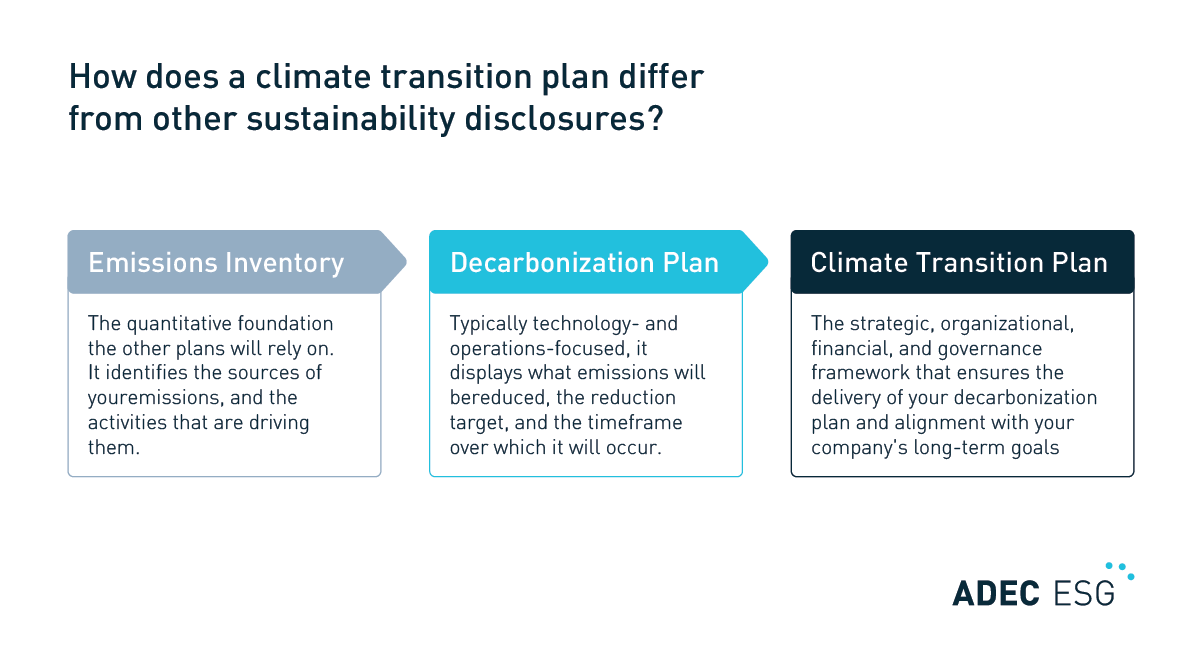
How does a climate transition plan differ from other sustainability disclosures?
Within the overwhelmingly crowded ESG reporting space, some types of disclosures begin to blend together. What are the differences between emissions inventories, decarbonization plans, and climate transition plans?
The key to understanding how these documents differ is to see them as different layers of the same system.
- An emissions inventory provides the data behind your GHG emissions.
- A decarbonization plan provides the technical pathway to reduce those emissions.
- A climate transition plan showcases the company-wide strategy to deliver those reductions.
The Science Based Targets initiative (SBTi) is a corporate climate action organization often utilized by companies and financial institutions worldwide to validate near-term and net-zero greenhouse gas emissions reductions targets presented in their decarbonization plan. While setting a science-based target validated by SBTi provides stakeholders with confidence that the targets are credible, validation alone cannot be considered a climate transition plan. A comprehensive climate transition plan shows how the decarbonization plan will be embedded into the business. It acts as a bridge between targets and delivery.
What are the benefits of having a climate transition plan?
A climate transition plan connects your climate goals to core business priorities and shows how climate action will lead to positive business and financial outcomes for your organization.
A transition plan can also benefit your organization across its operations, value chain, and shareholder relationships.
Own operations:
- Supports strategy development and implementation, risk mitigation, and long-term value creation.
- Creates competitive advantage by capitalizing on low-carbon opportunities.
- Empowers internal teams with strategies, direction, and commitment from leadership.
- Fosters organizational culture by setting up mechanisms for knowledge sharing, collaboration, and KPI alignment.
- Helps determine if your management strategy is sufficient given exposure to climate risks and opportunities.
- Prepares you for emerging disclosure regulations globally.
Value chain:
- Gives stakeholders visibility into your progress on public climate commitments.
- Reduces greenwashing concerns by clearly and transparently communicating measurable actions being taken to achieve your goals.
- Meets expectations of customers and consumers looking to reduce their own emissions.
- Communicates your ambition to suppliers and signals what you will require from them with innovation, sourcing, manufacturing, etc.
Investors and capital markets:
- Meets investors and financial institutions increasing expectations for portfolio companies to have and disclose transition plans.
- Provides decision-useful information to investors and lenders, enabling them to price risk and make capital allocation decisions.
- Provides forward-looking strategic information to the wider capital markets ecosystem, like credit ratings, and other tools.
What regulations and frameworks require climate transition plans?
Parallel to the multiple drivers and motivations behind the creation of a plan, many external pressures can also affect your development timeline. Regulators are increasingly calling for transition plans to be included in reporting and petitioning for greater accountability from businesses. Consolidation of ESG reporting standards and frameworks (i.e. IFRS) is another growing trend that can impact how climate transition plans are produced. While debates among regulators and disclosure organizations on the exact format of plans are commonplace, these documents are still seen as essential for stakeholders to evaluate climate risk and business resilience, and make informed decisions.
Regulatory requirements
While not all regulatory reporting frameworks require a climate transition plan—and many frameworks are currently evolving—there is a clear global shift toward harmonizing expectations, and transition plans are becoming a central part of climate risk reporting.
| IFRS S2 | CSRD (ESRS E1, ED Jul 2025) |
CSDDD | |
| Recommended | Recommended | Not Required* | |
| Guided by ISSB | Guided by EFRAG | Requirements vary by country | |
| Paragraph 14(a)iv. If the entity has a plan, it must disclose key assumptions and any dependencies. Although this is more accurately classified as a framework, many countries and regions are integrating this into their mandatory disclosures. | If the undertaking has a plan, it must disclose targets, decarbonization levers, strategy and business model alignment with 1.5°C, dependencies, and implementation progress. If the undertaking does NOT have a plan, it must disclose whether it will adopt one and when. | While requirements may vary by country, the CSDDD (CS3D) has removed its transition plan requirement as of December 2025.
|
Worldwide, an increasing number of countries are recommending (Canada, Bolivia, Malaysia, etc.) or requiring (Brazil, Australia, Indonesia, etc.) the implementation of climate transition plans in their guidance.
Voluntary reporting frameworks
Voluntary reporting and disclosure are crucial to meeting the growing expectations of stakeholders. Organizations have turned to these disclosures to demonstrate corporate responsibility and report sustainability data. The challenge arises when companies struggle to navigate the large ecosystem of standards, frameworks, and questionnaires. Along with reporting information such as emissions data, climate targets, risks and opportunities, voluntary disclosures are beginning to require comprehensive standalone transition plans.
SBTi (Draft NZS v2.0)
Required. This new requirement would apply to companies with currently validated net zero targets at their renewal validation.
Requirements are fully outlined in SBTi’s Net Zero Standard v2.0 and include certain key elements such as key actions, a high-level roadmap, approach to phase out fossil fuels, etc. The plan must be formally approved and adopted by the highest level of governance and updated every five years.
CDP
Recommended. CDP’s questionnaire is comprised of climate governance, risks & opportunities, strategy, and metrics & targets. While the content of a transition plan is indeed covered across multiple CDP sections, Module 5 serves a specific and important purpose to capture if a company has consolidated those elements into a single, comprehensive, organization-wide plan.
Module 5 of the questionnaire requests information concerning an organization’s business strategy, as it relates to the climate transition plan. The questions in this module ask about scenario analysis, transition plans, the effects of risks and opportunities on strategy and financial planning, CAPEX/OPEX alignment, etc. In this area, CDP looks for:
- Alignment with climate goals and a detailed roadmap on how the organization plans to meet those goals,
- Transparency on metrics and targets to assess if the targets are science-based and progress on those targets, and
- Strong governance with clear accountability mechanisms and board-level oversight of climate-related initiatives.
Common missteps in creating a climate transition plan
A lack of transparency, data, and cohesiveness can undermine the credibility of your climate transition plan. Below are a few missteps our team often sees when evaluating and improving transition plans for clients.
- Climate impact and overall strategy are not linked. Climate risks, opportunities, and impacts are starting to be assessed, but they are not informing overall business strategy.
- Not including financials. Organizations should provide insight into how transition progress will be measured or managed and how resources are allocated. This does not include financials and other quantifiable progress metrics (quantifiable targets, KPIs, etc.)
- No transparency on timing, uncertainties, and challenges. The plan should describe short- and medium-term actions, uncertainties in the long term, and challenges and risks to achieving your goals and targets.
- Planning relies too heavily on one person or team. Transition planning should not depend on the actions and responsibilities of one stakeholder. Cross-functional management and leadership buy-in is needed.
- Disorganized and out-of-date records. Key documents (i.e. HSE policy, materiality assessments, etc.) should be organized clearly, backed up securely, and regularly updated so you can tell if you’re on track.
Get started creating a robust climate transition plan
A climate transition plan is a living document supported by other reports, policies, internal tools, and dashboards. To enhance business resilience and evolve with the regulatory landscape, organizations should create complete climate transition plans aligned with the Paris Agreement. Not acting can expose an organization to significant transition and physical risks. These include regulatory penalties, supply chain disruptions, rising energy costs, and market shifts.
Many companies find that a structured transition plan helps them avoid these risks and identify operational efficiencies and cost-saving opportunities over time. An effective plan clarifies how the organization will address climate-related issues—governance, resourcing, capital allocation, scenario planning, and near-term milestones. Putting these elements into a structured plan helps internal teams stay aligned and ensures leadership can track progress, identify gaps early, and demonstrate accountability to investors and stakeholders.
Below, we outline steps you can take to get started on your own climate transition plan:
- Set a clear, strategic climate ambition
- Consider using a standardized framework
- Evaluate existing documentation and identify gaps
- Assess potential next steps
1. Set a clear, strategic climate ambition
Ask yourself:
- Do you have objectives and priorities for responding and contributing to the transition towards a low-GHG emissions, climate-resilient economy?
- How are you capturing opportunities, avoiding adverse impacts for stakeholders and society, and safeguarding the natural environment?
A GHG target is a great foundation and place to start. One way to begin setting these targets is to identify areas of your organization where the largest emissions occur or where there are the greatest opportunities for reduction. You can then define the components of the target; target type (absolute or intensity-based), boundaries, base year, completion date, etc.
Remember that this is a living document. Your transition plan will inevitably evolve over time as your organization learns and grows. Be honest about where your organization currently is on your progress journey—and how you’ll improve over the coming years.
2. Consider using a standardized framework
As regulatory bodies, corporations, and financial institutions increasingly understand their value, transition plans are gaining strong momentum globally. A variety of general and sector-specific guidelines and frameworks have been created to aid organizations in the development of these plans, but there is no universal consensus on the definition of their elements (i.e. aim, content, format, etc.). This often creates confusion among stakeholders. Organizations often merge a variety of frameworks to create a unique format that best portrays their strategic roadmap.
- Transition Plan Taskforce (TPT): Created in 2022, the Transition Plan Taskforce (TPT) provided guidance on transition plan disclosures, establishing baselines and common principles for best practice. In 2024, the TPT was folded into the IFRS Foundation, which is now responsible for the TPT’s materials and guidance documents. Increasingly, TPT has become a factor in CDP scoring. While companies aren’t scored explicitly for their alignment to TPT, TPT’s guidance has been integrated into its disclosure structure and uses TPT principles to define what a credible climate transition plan is.
- Ceres: Sustainability nonprofit Ceres also published its own Blueprint for Implementing a Leading Climate Transition Action Plan in 2024. The Blueprint lays out six action areas to create an action plan, guided by three fundamental principles: ambition, action, and accountability. This framework includes case studies from numerous companies to provide organizations with examples of strong transition planning practices and disclosures.
With SBTi NZS v2.0 and regulations including criteria about climate transition plans, an increasing number of organizations will adopt plans, resulting in standardization over time. To begin, companies should start following the basic structure of the TPT and Ceres:
- Ambition: Foundations
- Action: Implementation Strategy, Engagement Strategy
- Accountability: Governance, Metrics & Targets
For some organizations, Ceres can be a slightly easier framework to utilize, as their language is easier to interpret, while the criteria in TPT can be rather granular. As a living document, a climate transition plan is ultimately supported by other reports, internal tools, and dashboards. Plans should therefore be on the shorter side and easily updated.
3. Evaluate existing documentation and identify gaps
We recommend mapping credible climate transition plan elements against their existing documentation. This process will enable stakeholders to identify areas where information is missing and where strategy needs to be developed to ensure the final climate transition plan meets the requirements set by regulators and voluntary disclosures.
- Take stock of components you already have in place. You may already have reporting, strategies, or processes in place that can help you start building your transition plan, such as TCFD reports, CDP disclosures, GHG inventories, targets, risk process, supplier mapping, etc.
- Evaluate what’s missing. Identify gaps in your sustainability program that you’ll need to achieve your climate ambition, including key commitments, strategies, actions, and data.
4. Assess potential next steps
Depending on your key gaps and barriers, consider the following potential next steps:
- Map key stakeholders: Map key stakeholders to identify key internal (employees, executive management, etc.) and external (investors, suppliers, industry associations, etc.) groups and how they engage with the organization.
- Assess climate-related risks and opportunities: Conduct a scenario analysis to assess your organization’s physical and transition risks, and climate-related opportunities.
- Measure emissions footprint: Conduct a robust inventory of your scope 1, 2, and 3 GHG emissions. This will allow you to identify the largest emission sources and where to focus efforts.
- Engage leadership: The board and leadership should have a shared understanding of how climate adaptation and transition considerations are integrated into corporate strategy, objectives, and financial planning. Leadership can also help provide the buy-in needed to push these strategies forward.
- Ensure ownership across the organization: Build cross-company ownership across all functions, divisions, and business lines with a cross-functional working group.
- Identify transition levers: Identify your organization’s transition levers – the range of potential actions your organization can take to facilitate your climate transition.
Climate transition plans provide clear pathways for organizations to not only attain sustainable objectives but showcase clear action on commitments to a variety of stakeholders. Research shows that investors and customers prefer to invest in and purchase from climate-conscious businesses.
Climate transition plans instill confidence in stakeholders and ensure that your organization can stay competitive. When it comes to climate transition plans, they act as the key point of accountability and planning of climate action.
Interested in learning more about how ADEC ESG can help you put together a robust climate transition plan? Talk to our team today, or check out our discussion on transition plans with CDP for free—Climate Transition Plans and CDP: Creating a Value-Building Cycle.
This blog provides general information and does not constitute the rendering of legal, economic, business, or other professional services or advice. Consult with your advisors regarding the applicability of this content to your specific circumstances.